
How to Choose the Right Access Control System for a Multi-Site Business
"Multi-site businesses need access control that centralizes management without creating complexity. This guide covers credential types, platform options, and what questions to ask before buying."
Choosing access control for a single location is relatively straightforward. Choosing a system that works across three, ten, or fifty locations — with different door types, different user populations, and different compliance requirements — is a different problem entirely. This guide covers what actually matters for multi-site deployments.
Key Decisions
- Cloud vs. on-premise: cloud-managed systems are strongly preferred for multi-site because management is centralized without a VPN or server at each location.
- Credential type: keycards are cheapest upfront; mobile credentials eliminate card management overhead; biometrics add friction but remove card-loss risk.
- Reader compatibility: ensure new readers work with your existing door hardware before specifying replacements.
- Integration: does the system connect to your HR/HRIS, your camera platform, and your alarm system?
- Licensing model: per-door per-year is standard; understand whether the rate is locked across all sites.
Why Multi-Site Access Control Is a Different Problem
The defining challenge for multi-site access control is centralized visibility with site-level flexibility. You need a single administrator who can grant a new employee access to all locations on day one, revoke that access immediately when they leave, and audit who entered which location at what time — without logging into a different system at each site.
At the same time, individual sites often have different requirements. A head office has different access zones than a warehouse. A retail location has different hours and shift schedules than a corporate campus. The system needs to handle both.
Cloud vs. On-Premise: The Answer for Multi-Site Is Usually Cloud
On-premise access control requires a server at each location, a VPN connection between locations, and an IT team that can manage both. For organizations with a dedicated IT department and strict data sovereignty requirements, this is sometimes the right choice.
For most multi-site businesses, cloud-managed access control is the correct answer. Management is centralized. There is no server to maintain at each location. Updates are automatic. And administrators can manage every door at every location from a single browser-based dashboard. The tradeoff is an ongoing annual licensing fee — typically $300–$600 per door per year — versus a higher upfront cost for on-premise.
Credential Types: What Fits Your Operation
Keycards and fobs are the most common choice. They're inexpensive ($5–$15 per card), universally compatible, and familiar to every employee. The operational downside is management overhead: lost cards need to be deactivated and replaced, and cards can be shared or cloned.
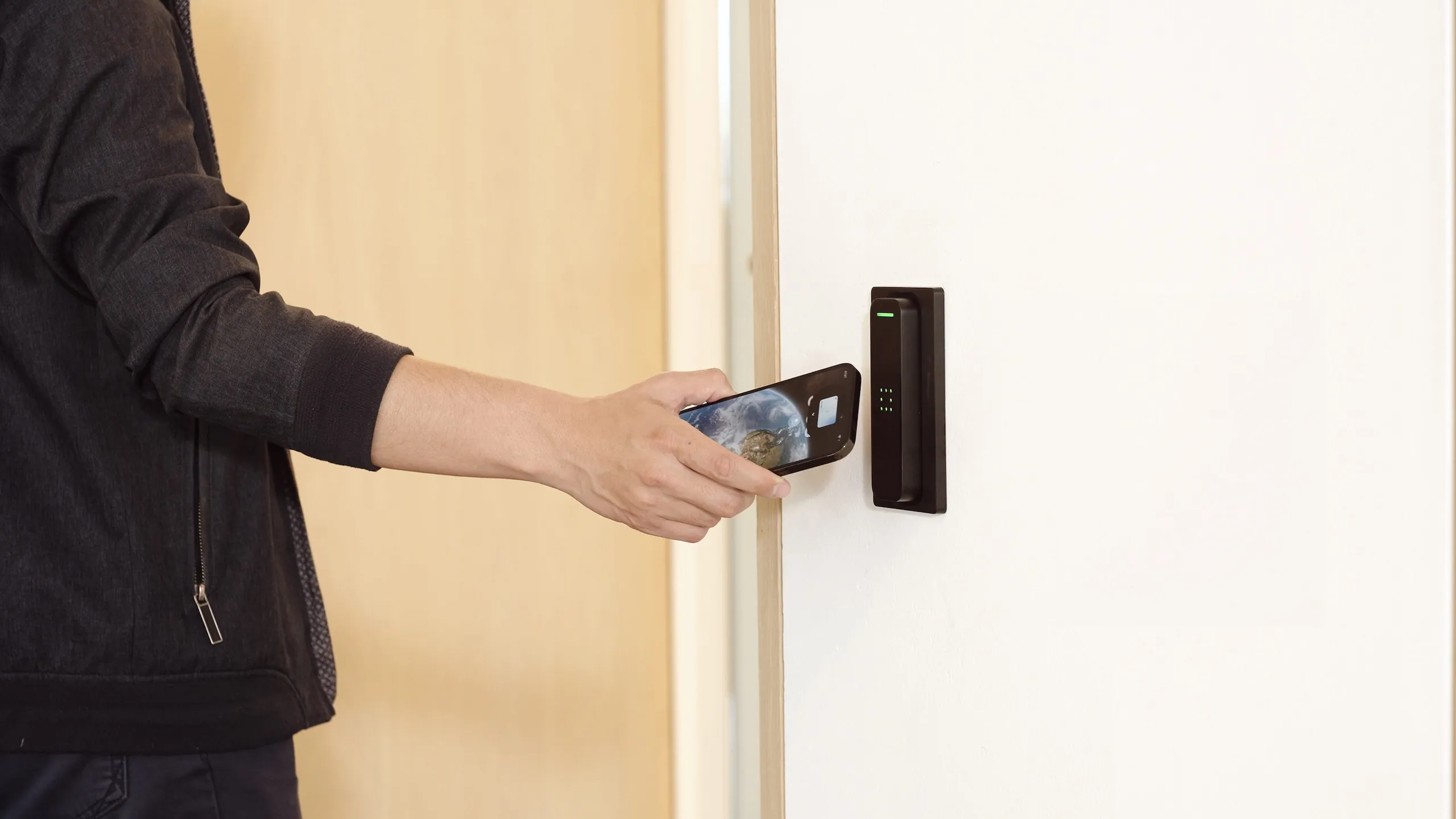
Mobile credentials use an app on the employee's smartphone instead of a physical card. The main advantages are that phones are rarely forgotten, credential issuance and revocation can be tied to your HR system, and sharing credentials is much harder. The main concern is employee privacy — most platforms allow a credential without requiring location tracking, but confirm this before deployment.
Biometric readers (fingerprint or facial recognition) are increasingly common for high-security zones. They eliminate card management entirely. The tradeoffs are higher hardware cost ($800–$1,500 per reader vs $150–$400 for a standard reader), slower throughput at busy entry points, and privacy compliance requirements that vary by province.
PIN codes alone are not recommended for any security-sensitive application. They're sharable, forgettable, and create no audit trail tied to an individual.
Integration: The Multiplier That Makes Access Control Actually Useful
Access control that stands alone is an upgrade from a lock and key. Access control that integrates with your camera system, your HR platform, and your alarm system is an operational tool.
The most valuable integrations for multi-site businesses are:
- HR/HRIS integration: When a new employee is added to your HR system, their access is provisioned automatically. When they leave, it's revoked. This eliminates orphaned credentials — a major security gap in manually-managed systems.
- Camera integration: When a door is accessed, the camera feed for that entry point is bookmarked. When an access event is suspicious, the associated footage is one click away.
- Alarm integration: Arm and disarm alarm zones based on access control schedules. When the last person with access to a zone badges out, the zone arms automatically.
What to Ask Before You Buy
How is the system managed across multiple locations?
Should be a single dashboard — not a separate login per site.
What happens to door access if the internet goes down?
Doors should use local caching — the door controller holds access rules and continues operating during an outage.
What does the licensing cost per door per year, and is that rate locked?
Understand the full five-year cost, not just year one.
Can the platform integrate with our HR system?
Ask for a specific list of supported HR platforms, not just a general 'yes we have an API.'
Who manages the system day to day after installation?
Understand whether you need dedicated IT resources or whether the integrator provides managed services.
Typical Costs for Multi-Site Access Control
Hardware per door runs $1,200–$2,800 depending on reader type and door hardware complexity. Annual cloud licensing typically runs $300–$600 per door per year. For a 10-location deployment with 3 doors per site (30 doors total), expect hardware and installation in the range of $36,000–$84,000, plus $9,000–$18,000 per year in licensing.
These ranges vary based on existing door hardware, cabling requirements, and reader specification. A site assessment at each location is the only reliable way to get an accurate number.
Get a site-specific estimate
Our Cost Estimator covers access control across any number of doors and sites. Start there, then connect with us to validate the assumptions against your actual locations.
Frequently Asked Questions
Cloud-managed access control is strongly preferred for multi-site businesses because management is centralized without requiring a server or VPN at each location. Platforms like Verkada allow a single administrator to manage every door at every location from one dashboard.